Candidate Q&A
Honolulu Civil Beat
Honolulu Civil Beat
/n9daqpu6wgc0zk691pjq2r9429oe)
By The Civil Beat Staff / June 24, 2026
Originally published on Honolulu Civil Beat - Read it here
Civil Beat has asked candidates for the Hawaiʻi General Election on Nov. 3 to answer a survey about where they stand on various issues and what their priorities will be if elected.
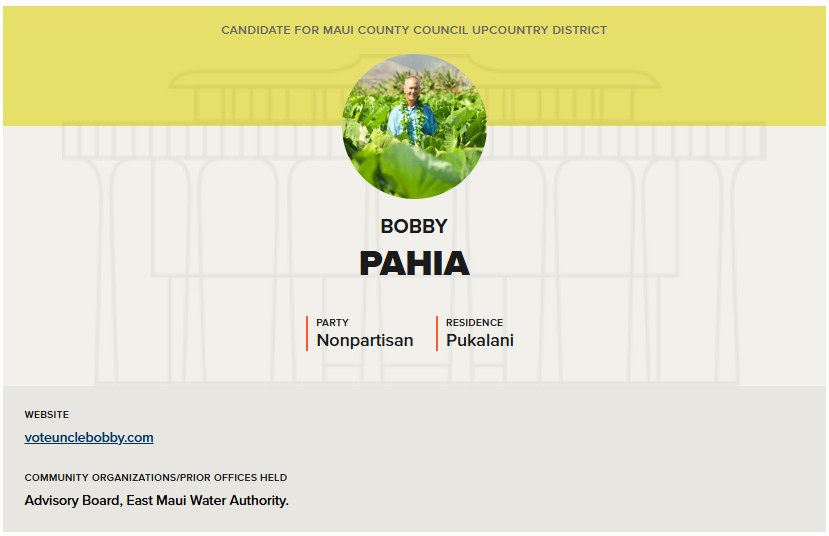
The following comes from Bobby Pahia, Nonpartisan candidate for Maui County Council Upcountry District.
Why are you best suited for the job of council member, and why do you want the job?
As a family business owner and community leader, I’ve spent decades investing in our food security, caring for ʻāina, mentoring youth and building relationships across Maui Nui. Through this, I’ve seen how public policy can either strengthen or impede our ability to thrive collectively. I’m running to collaborate on solutions that reflect our shared values as residents of Maui County. My goal is generational impact, so our keiki and moʻopuna can continue to make Maui Nui their home.
What is the biggest issue facing Maui County, and what is the first thing you would do to address it in the first six months after being elected?
The biggest issue facing Maui County is the rising cost of living, driven by skyrocketing housing prices. By applying regenerative principles to housing, water and planning, we can strengthen our communities while preserving what makes Maui County special. Our families need pathways to stay in this place we call home. I will focus on policies that make housing more affordable for generations, while strengthening community control of our water and other shared resources.
Here’s one question from a constituent: What is your position on upcountry speed humps? Would you remove them? Why or why not?
Speed humps are intended to slow traffic and save lives, which is an important goal. However, we’ve relied on this solution so heavily that, in some cases, the solution has become part of the problem. It’s a quality-of-life issue that can delay emergency response when seconds count. Some speed humps have been installed improperly, causing vehicle damage and adding to the cost of living. We need to consider other ways to slow traffic down and strategically remove those that aren’t needed.
The county now has a law on the books to effectively phase out several thousand vacation rentals in apartment-zoned districts starting in 2029. The companion measure to grandfather in more than half of those properties has since been rejected by all three planning commissions. What would you do as a council member about this?
Bill 9 is law and reducing short-term rentals is just one piece of the overall housing puzzle. My focus is on moving forward with new solutions, not undoing years of council and community work. Creating a new zone through a “companion measure” is an unnecessary concession. Existing hotel zones already serve the purpose for properties that operate like hotels to upzone. The council’s TIG report should be shared with the public to be better informed. In a housing crisis, every home that can house residents should.
Hawai‘i has a long-stated goal of growing more of its own food. What would you do to further that effort toward increased food sustainability?
From COVID to the wildfires, we’ve seen the gaps in our food system. We must invest in local food security, so we can feed ourselves when global supply chains are disrupted. With our county Department of Agriculture, we can lead by investing in infrastructure to support farmers, ranchers and hunters, including meat-processing capacity. We should help create value-added products, reduce costs through farmworker housing solutions with safeguards and prioritize water access for agriculture.
The county has been moving forward with plans to bring much more of Maui’s water supply under public ownership instead of private. What steps would you take to get a better handle on Maui’s water future?
In 2022, 64% of voters approved creating the East Maui Water Authority (where I serve on the advisory board), and it’s time government listens. Public trust resources must be under public ownership. I’d work with the state to streamline transfer to county control and leverage public finance options to repair the systems and prevent waste. Water is life. It is the solution to many of our problems. Disruption of mauka to makai flow of water has caused so much damage. It’s time to set things right.
Overtourism can degrade the environment, contribute to wear and tear on infrastructure, generate traffic and disrupt neighborhoods. How well is Maui managing the tourism industry that drives its economy? What would you do differently?
We must find better balance with tourism. Visitors are welcome, but we’re stretching limited resources too thin. Our people love to give but we can’t give so much away there’s nothing left. Maui Island Plan ratios show we’re over capacity. We need a circular economy that provides better reciprocity and reinvests tourism profits in our communities and environment, instead of sending profits outside of Hawai’i. Tourism generates money for businesses, but not our people. It’s time to change that.
What should Maui County do to get in front of climate change rather than just reacting and adapting to it?
It’s a little late to get fully ahead of climate change, but we must act now. “Just keep planting.” It’s my motto for a reason. Trees grow water, prevent landslides/flooding, and create firewise communities. We need to restore wetlands to filter runoff and protect shorelines. These nature-based solutions and green infrastructure build resilience while protecting our people and ʻāina. We already have the blueprint. Existing Maui Nui groups use ahupuaʻa-inspired methods to lead this climate response
Maui has been targeted for enforcement by ICE agents. What will be the position of your office to requests for more cooperation between county law enforcement and federal authorities?
I would not support any request that pulls local law enforcement off their critical jobs or resources away from the county. We lack manpower to loan officers to anyone. Hawaiʻi is built on the backbones of immigrants and native people. I will never support weaponizing law enforcement to harass our own people. Local police should prioritize saving lives and protecting our communities from violent crimes – not civil issues like federal immigration enforcement.
The $1.6 billion federal Community Block Development Grant is the largest disaster loan in U.S. history, but it falls far short of the estimates for recovery from the 2023 wildfires. What would you do to make those dollars count?
CDBG-DR’s goal is recovery. I’d invest funds strategically to maximize quality of life returns: prioritizing stable housing for displaced residents, resilience efforts to prepare for future weather events, and collaborating with Department of ʻŌiwi Resources to preserve community spirit and cultural history. I’d work with large landowners on permaculture, fund fire-resistant design, water infrastructure and small business recovery, ensuring these dollars rebuild our community sustainably.
The cost of living on Maui continues to remain high. How can county government help working and middle-class people buy homes, pay rent or otherwise afford to live and work on the island?
To address high cost of living, we need to raise income AND cut costs. I’d expand successful pilot programs, study rent stabilization and utility assistance models from other states, and invest in workforce development to diversify into reliable industries. We need more local production – like my friend who used invasive tree lumber for his home. Shipping everything in raises costs; using local resources keeps profits here and lowers expenses for working and middle-class families.
What is your assessment of programs combating invasive species in Maui Nui and what other measures would you advocate for you in office?
Programs combating invasive species in Maui Nui are doing their best with limited resources, but they need more funding. The situation is dire! CRB was just found in traps across from our farm. We have a small window to act before invasive species take over, making recovery more difficult and expensive. Prevention is key! I’d advocate for restricting movement of organic material around the county and isolating imports to enable proper inspections and reduce risks.